LifeLine — disaster response and evacuation simulator
A fictional city modelled as a weighted graph, with a C++17 engine that routes emergency vehicles, spreads a disaster, computes evacuation capacity with max-flow and finds the roads whose loss cuts the network — every data structure written from scratch.
- checks cross-verified against networkx
- 96
- nodes settled, A* vs Dijkstra
- 8 vs 24
- city graph
- 40 nodes · 83 roads
The actual problem
A DSA course teaches ten algorithms in isolation and then asks for a project. The interesting version of that assignment is not implementing them again — it is putting them in one system where each one has a job that the others depend on, and where a wrong answer is visible rather than hidden behind a test case.
So: Indrapur, a fictional city of 40 locations and 83 roads, held as a weighted graph. A flood spreads across it, and the engine has to keep the city working.
What it does
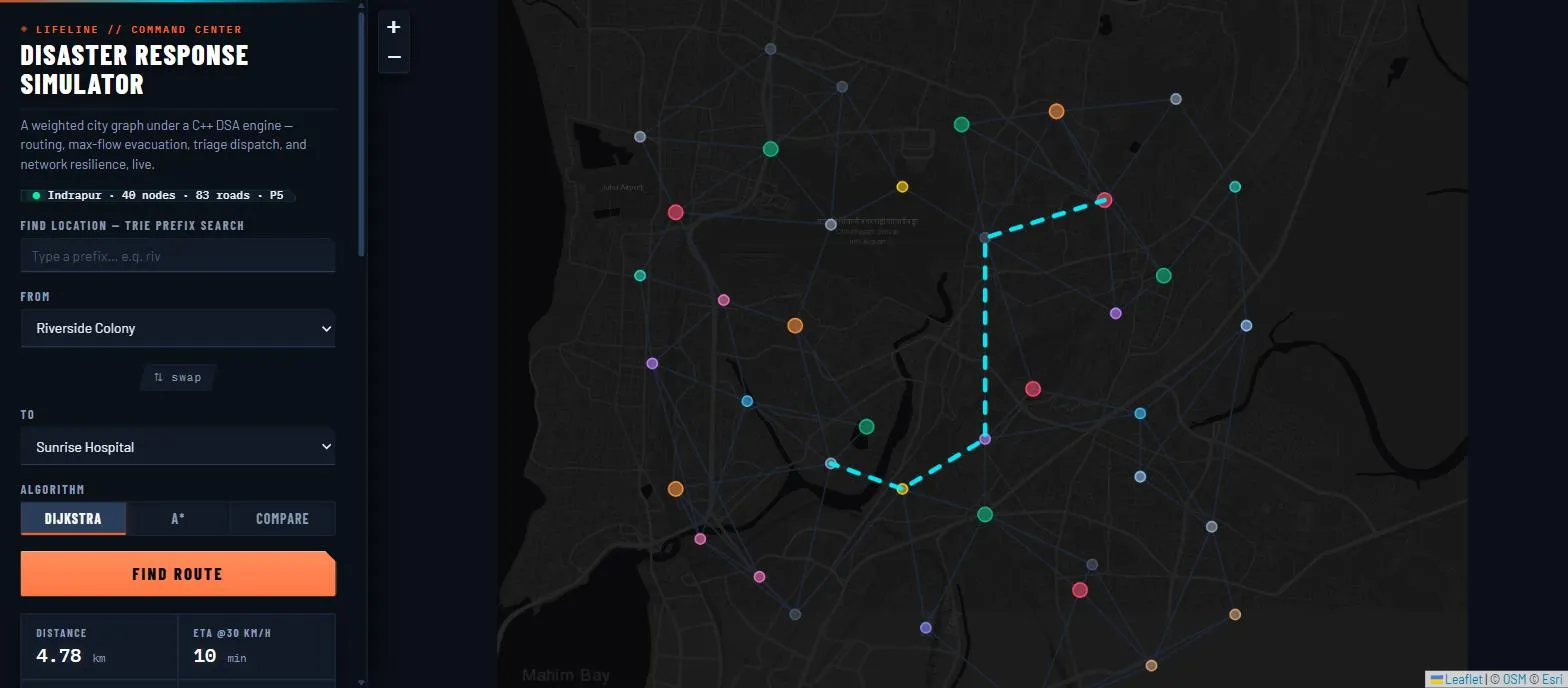
Routing. Dijkstra and A* over the road network, with a haversine
heuristic. On Riverside Colony → Sunrise Hospital both return the same optimal
4.78 km path, but Dijkstra settles 24 nodes to A*’s 8 — the point of the
comparison view is that the heuristic changes the search, not the answer. The
heuristic is admissible by construction: tools/generate_city.py guarantees
every road is at least as long as the straight line it spans.
Disaster and evacuation. A level-order BFS from the epicentre blocks roads ring by ring. The same route reroutes to 5.42 km over the north bridge; at two rings both southern approaches are cut and the west→east trip becomes impossible. Evacuation capacity is Edmonds–Karp max-flow from a super-source over danger nodes to a super-sink over shelters, and the min-cut names the exact bottleneck roads — the tests assert the duality on the real graph.
Dispatch. Incidents enter a custom max-heap for triage, with a monotonic
sequence number breaking ties so equal severities stay FIFO. Each incident runs
one dijkstraAll() — not one Dijkstra per vehicle — because the road graph is
undirected and distances are symmetric. Supply loading is 0/1 knapsack DP with
backtracking, which beats the greedy value-per-weight order it is compared
against.
Resilience. One Tarjan DFS finds bridges and articulation points from the
same disc/low arrays. On the healthy city both sets are empty — it was
generated 2-edge-connected with minimum degree 3, so there is no single point of
failure to find. Under flood, 5 critical roads and 7 critical junctions appear.
Prim and Kruskal both run and their totals are asserted equal, which is a proof
line rather than a feature: distinct edge weights mean the MST is unique.
Engineering notes
No STL containers in the algorithm paths. The binary min-heap and max-heap, the
separate-chaining hash map (djb2, load factor 0.75), the trie behind prefix
search and the Union–Find with path halving are all in backend/src/ds/. That
was the point of the exercise — std::priority_queue would have hidden the part
worth learning, including the decision to use lazy deletion instead of
decrease-key.
The backend is a single static binary with no external dependencies: cpp-httplib
and nlohmann/json are header-only, and the built React frontend is served by the
same binary at /. SQLite is a compile-time #ifdef with a JSONL fallback, so
the default build needs nothing installed.
Testing is the part I would defend hardest. tools/verify_city.py is an
independent pure-Python re-implementation, and the 96 checks compare against it
on the real graph: shortest paths across all 1,600 node pairs, max-flow/min-cut
duality, the bridge and articulation sets, MST totals, diameter and centrality.
Cross-verification against a second implementation catches the class of bug that
a hand-written expected value never does.
What I would change
Dispatch is greedy, so it is locally optimal per incident rather than globally optimal — min-cost matching via the Hungarian algorithm at O(n³) would be the correct offline answer. Greedy is defensible here because dispatch is an online problem and incidents arrive over time, but that is a justification, not a proof, and I would like to measure the gap.